Chernobyl as warfare
Voices from ChernobylChernobyl as warfare is a way witnesses make sense of a disaster that resembles war in its mobilization, danger, evacuation, and inherited emotional scripts, yet exceeds the comparison because radiation has no visible front and can enter ordinary life through food, air, and land. The interviews return to wartime images not to claim that the events are identical, but to show how a society trained to anticipate attack reached for familiar forms of courage and endurance when confronted with a threat it did not know how to understand.
The war remembered before the disaster
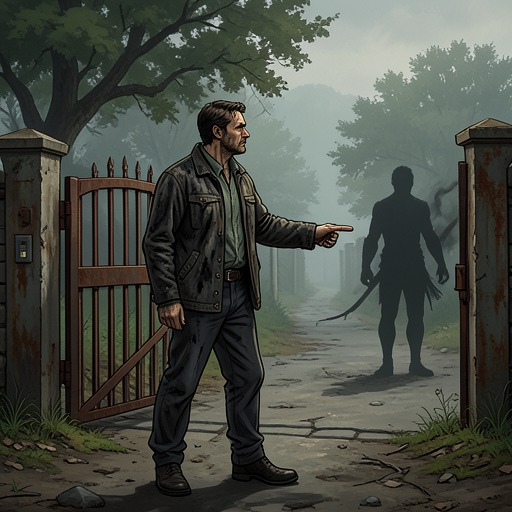
A speaker describes waking in a hotel to monotonous noise and strange blue lights: dozens of trucks marked with red crosses and sounding sirens move through the street in silence. The scene brings back fragments of childhood war films and their stark question about what a person should do when everyone else has left town. In Khoyniki, the actual evacuation soon seems to follow the same remembered imagery. Children are loaded onto buses; a girl waves to her mother with a gesture of bravery and confidence in victory. The speaker notices that people, and even the act of filming them, appear to repeat scenes from familiar war cinema, especially The Cranes Are Flying. Wartime culture supplies a form for saying farewell when the present offers few usable instructions.
That inherited script is not confined to public ceremonies. One speaker imagines reaching Minsk and finding that it, too, is being evacuated, and wonders how to say goodbye to a wife and son. The imagined farewell belongs to the same repertoire of brave gestures. In the family background behind it, the speaker’s father wore military clothing despite not serving in the military; concern with money or one’s private life had been treated as bourgeois or unpatriotic, while hardship was considered normal. Having survived catastrophe, the parents’ generation seemed to require catastrophe of the next generation as well, as if suffering were a test that made people real. The expectation of war was thus both a public preparation and a private inheritance.
Similarities and limits of the analogy
The testimony repeatedly insists on a distinction between Chernobyl and war. A speaker who survived the Siege of Leningrad as a child recalls direct shooting, prolonged hunger, people burning furniture and books for fuel, and frozen bodies left in the street because others lacked the strength to help. Against that visible, immediate struggle, the contaminated countryside could look deceptively intact: gardens were blooming. The comparison fails at precisely the point where Chernobyl’s threat becomes most difficult to grasp. There is no clear line of fire and no reliable sign that a seemingly ordinary place is safe.
Another speaker recalls that people had prepared for nuclear war by building shelters, imagining that the atom could be escaped like shrapnel. But radiation was understood to be everywhere: in bread and salt, in what people breathed and ate. The familiar prospect of hunger could be imagined, even in its extremity; the possibility that everything was poisoned could not. This difference unsettles the meaning of military readiness. People had trained to block or liquidate a nuclear attack, not to remove radionuclides from their own bodies. They had prepared for war as a recognizable event and found themselves facing contamination without a clear boundary or endpoint.
The comparison also registers a difference in scale and duration. In one account, people measure the passing years against the four-year war and say they have lived through what amounts to two wars. Yet familiar measures do not settle the meaning of the disaster: some believe the danger has passed, some expect recovery, some fear imminent death, and others want to leave or insist that life must continue. The range of reactions makes the analogy less a single explanation than a shared language for experiences that remain unresolved.
Mobilization, evacuation, and the work of danger
The disaster takes on a military appearance in the movement of people and machinery. Soldiers enter villages to evacuate residents while streets fill with armored personnel carriers, trucks under green canvas tarps, and tanks. For people who have already lived through war, leaving their homes in the presence of soldiers compounds the pressure of displacement. Explanations of blame shift: some initially fault the Russians and the location of the power station; others blame the Communists. The evacuation makes the war analogy visible in the landscape, even as the cause and nature of the danger remain harder to read.
The labor performed in response carries the analogy from appearance into bodily risk. Four hundred miners worked around the clock to blast a tunnel beneath the reactor, intended to allow liquid nitrogen to freeze the ground beneath it and prevent the reactor from reaching groundwater. Miners came from Moscow, Kyiv, and Dnipropetrovsk. They worked naked in temperatures reaching fifty degrees Celsius, pushing small cars while crouched on all fours, amid hundreds of roentgens. The speaker notes that they are now dying, while emphasizing that their work helped avert what might otherwise have happened. Within this account, describing them as heroes rather than merely victims gives their dangerous labor a place in a story of war, though the war itself was officially called an accident or catastrophe.
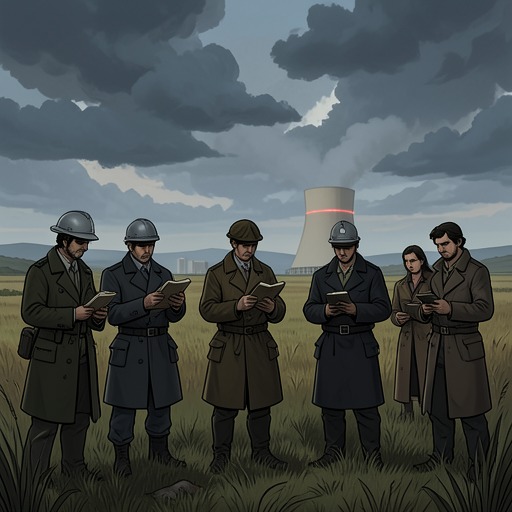
A separate account of cleanup on the reactor roof shows how orders and consent could coexist uneasily. Reserve officers were called from a factory, told they were volunteering for Chernobyl, and taken without first going home; one was not even allowed to tell his wife himself. After months spent evacuating people, the squadron stepped forward when told it would be sent to the roof. The task was to clear graphite and melted bitumen and throw debris into an opening. Instructions allowed only forty or fifty seconds there, but the work required several minutes to reach the spot, load a wheelbarrow, and clear the debris. Dosimeters reached their limits, and the men joked quietly about predictions that they might live only five years. Military discipline could organize action, but it did not make the danger measurable or harmless.
Secrecy, endurance, and the meaning of heroism
Wartime habits also shape what witnesses say about truth. One speaker calls the scale of lying associated with Chernobyl comparable only to the lies of the major war. Television reports show dosimeters being used on milk, fish, chocolate, and pancakes to reassure viewers, although the military instruments in use were designed to measure background radiation, not individual foods. The staged demonstration gives a familiar public image of official reassurance, but its method cannot establish what it claims. In this account, the machinery of reassurance deepens rather than resolves the problem of how to live with contamination.
Another testimony places scientific responsibility within the same conflict. People ask who is to blame—the scientists, station personnel, director, or operators—and some demand that nuclear stations be closed and scientists jailed. The speaker resists treating knowledge itself as criminal, arguing that scientists, too, are victims of Chernobyl, and frames the demand as a wish to understand how life can continue after it. At the same time, the scale of exposure is described as a vast experiment: ten million Belarusians, two million living on poisoned land, while researchers arrive from elsewhere to collect information. The language of war and the language of science meet in the unsettling possibility that people have become material for observation.
The concept’s central tension is therefore not that Chernobyl simply repeats wartime heroism. War offers an enemy, a front, and a moment when danger announces itself; radiation can leave a garden in bloom while making its produce suspect, and can persist after the evacuation buses have gone. Yet wartime memory gives witnesses images for departures, discipline for dangerous work, and a vocabulary for honoring people exposed to lethal conditions. The same memory can also normalize suffering and obscure the newness of the threat. Chernobyl as warfare names both the force of that inherited framework and its failure: people reached for the old language of war because it was familiar, then found that the atom had made the familiar world itself unsafe.